FLUX.1 — text-to-image on Apple silicon
mlx-diffuser ships faithful, weight-compatible ports of FLUX.1, Black Forest Labs' 12B-parameter rectified-flow image model, so you can run the official checkpoint natively in MLX. Loading, conversion, text encoding, denoising, and decoding all happen on Metal.
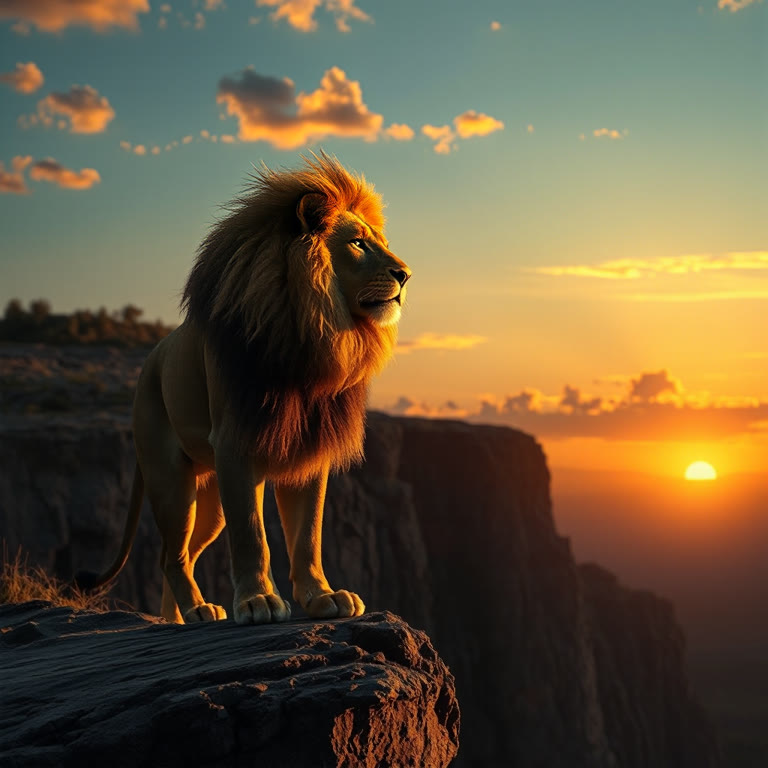 |
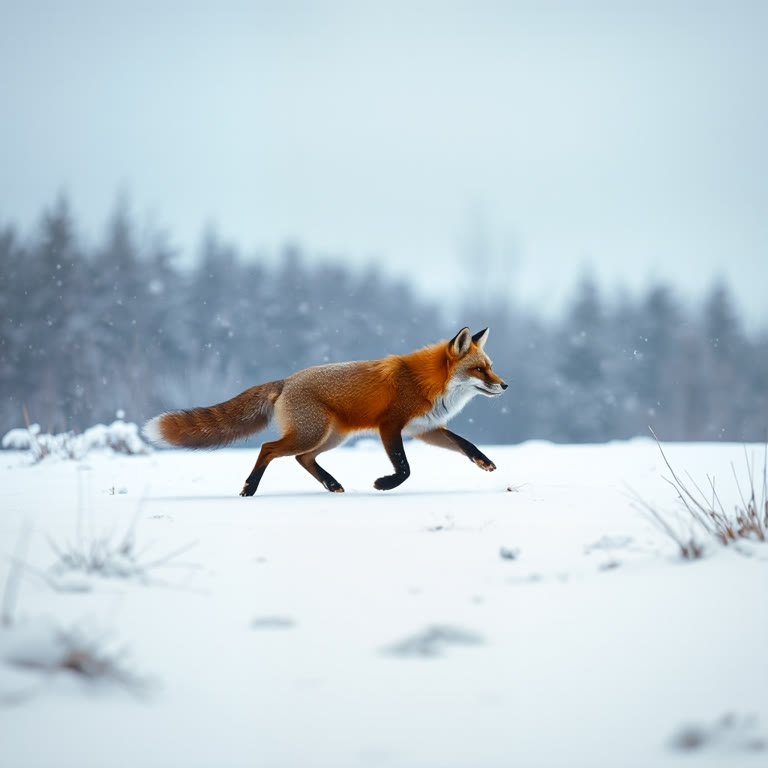 |
| "a majestic lion standing on a cliff at sunset, photorealistic, cinematic" | "a red fox trotting through snow, cinematic" |
FLUX.1-schnell, 1024×1024, 4 steps, 4-bit — generated on an M1 Pro (16 GB).
The fox is straight from the CLI: mlx-diffuser generate --model flux --prompt "a red fox trotting through snow, cinematic" --tile-vae
Components
| Model | Role |
|---|---|
CLIPTextModel |
CLIP ViT-L/14 — provides the pooled text embedding for modulation |
T5EncoderModel |
T5-XXL — the per-token text sequence for joint attention (4096-dim) |
FluxTransformer2DModel |
the MMDiT: 19 double-stream + 38 single-stream blocks |
AutoencoderKLSD |
the 16-channel FLUX VAE (÷8 spatial, shift+scale latents) |
Every port is verified numerically against diffusers/transformers — the transformer, T5, and VAE are all bit-exact (cosine 1.0).
Memory: FLUX is big, so quantize
FLUX.1 is a 12B-parameter transformer — about 24 GB in bf16, which does not fit on a 16 GB Mac. The pipeline therefore loads the transformer and T5 encoder 4-bit by default, bringing the whole thing to roughly 10 GB:
| Component | bf16 | 4-bit (default) |
|---|---|---|
| Transformer (12B) | ~23 GB | ~6.5 GB |
| T5-XXL encoder | ~9.5 GB | ~2.5 GB |
| CLIP-L | ~0.25 GB | — (bf16) |
| VAE | ~0.16 GB (fp32) | — |
Conversion is memory-safe: weights are memory-mapped and quantized in small chunks (each
bf16 tensor is freed right after its 4-bit version is computed), so the full bf16 model is
never resident — converting the 12B transformer peaks at ~6.5 GB, not ~24 GB. Loading
the whole pipeline peaks at ~9.7 GB, and a 1024px generation at ~14 GB with
tile_vae=True — comfortably inside 16 GB, no swapping.
One-line generation
from mlx_diffuser import FluxPipeline

pipe = FluxPipeline.from_diffusers("checkpoints/flux1-schnell")  # 4-bit, converts on load
image = pipe(
    "a majestic lion standing on a cliff at sunset, photorealistic, cinematic",
    height=1024, width=1024, num_inference_steps=4,  # schnell needs only ~4 steps
)                                                    # (1, 1024, 1024, 3) in [-1, 1]
from_diffusers runs the transformer and CLIP in bf16 (4-bit weights) and the VAE in
fp32. height/width must be multiples of 16 (the 8× VAE downsample times the 2×2 patch
packing). The runnable script is
examples/flux_text_to_image.py.
schnell vs dev
schnell (Apache-2.0) is guidance-distilled: ~4 steps, no classifier-free guidance.
dev adds a distilled guidance embedding — pass guidance_scale≈3.5,
num_inference_steps≈50, and max_sequence_length=512:
pipe = FluxPipeline.from_diffusers("checkpoints/flux1-dev")
image = pipe(prompt, num_inference_steps=50, guidance_scale=3.5, max_sequence_length=512)
The checkpoint converter
mlx_diffuser.converters maps each diffusers/transformers component folder onto the
matching MLX model, reading safetensors natively (no PyTorch) with a build-and-fill check
so an architecture mismatch fails loudly. The transformer and T5 are pure-Linear models,
so conversion is essentially an identity remap onto the channels-last tree; only the VAE
needs conv kernels reordered.
Going faster & lighter
4/8-bit weights (quantize_transformer, quantize_t5) are the main lever — 4-bit is
the default. First-Block caching (cache_threshold > 0) skips the bulk of the
transformer on steps where the first block barely changes; with schnell's 4 steps the win
is modest, but it helps the longer dev schedule:
image = pipe(prompt, cache_threshold=0.1)
tile_vae=True decodes the final latent in feather-blended tiles. At 1024px the fp32
VAE decode is the memory high-water mark (~18 GB); tiling brings the whole generation under
14 GB so it fits a 16 GB Mac without swapping:
image = pipe(prompt, tile_vae=True) # recommended on 16 GB machines
release_text_encoders=True frees CLIP + T5 right after encoding, lowering memory
before the denoising loop (the prompt is already encoded by then):
image = pipe(prompt, release_text_encoders=True)