Stable Diffusion XL — text-to-image on Apple silicon
mlx-diffuser ships faithful, weight-compatible ports of Stable Diffusion XL, so you can run the official checkpoint natively in MLX. Loading, conversion, text encoding, denoising, and decoding all happen on Metal.
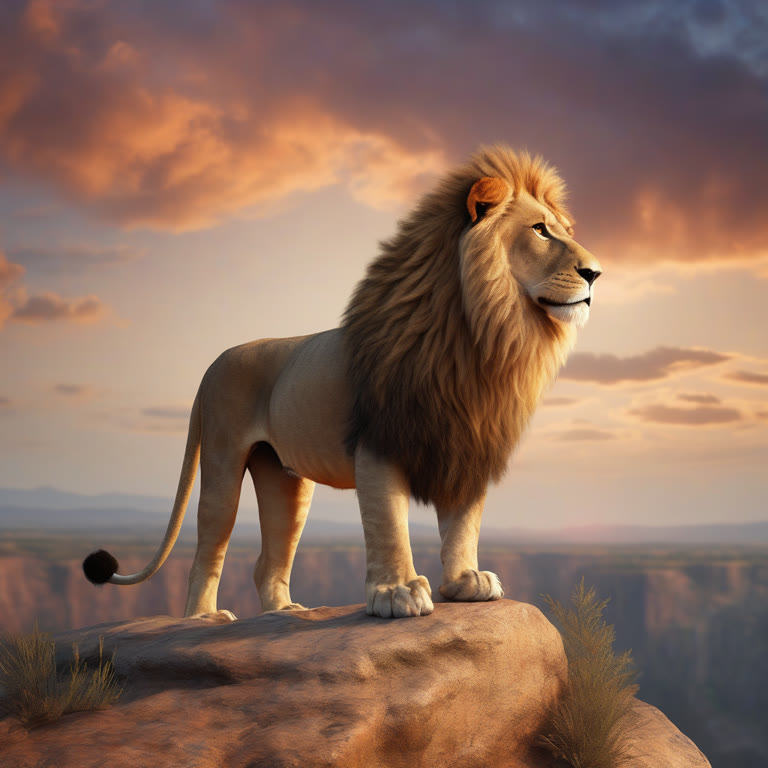
"a majestic lion standing on a cliff at sunset, photorealistic, cinematic" — SDXL base, 1024×1024, generated on a Mac
Components
| Model | Role |
|---|---|
CLIPTextModel ×2 |
CLIP ViT-L/14 + OpenCLIP ViT-bigG/14 text encoders (2048-dim joint context) |
SDXLUNet |
the cross-attention UNet operating on 4-channel latents |
AutoencoderKLSD |
the VAE (÷8 spatial), with optional tiled decode |
Every port is verified numerically against diffusers/transformers — the UNet, VAE, and both text encoders are bit-exact (cosine 1.0), and the Euler scheduler matches diffusers' sigmas/timesteps exactly.
One-line generation
from mlx_diffuser import StableDiffusionXLPipeline

pipe = StableDiffusionXLPipeline.from_diffusers("checkpoints/sdxl-base-1.0")  # converts on load
image = pipe(
    "a majestic lion standing on a cliff at sunset, photorealistic, cinematic",
    negative_prompt="blurry, low quality",
    height=1024, width=1024, num_inference_steps=30, guidance_scale=5.0,
)                                              # (1, 1024, 1024, 3) in [-1, 1]
from_diffusers runs the UNet and text encoders in fp16 (SDXL's native precision) and
the VAE in fp32 (SDXL's VAE overflows fp16). height/width must be multiples of 8.
The runnable script is
examples/sdxl_text_to_image.py.
Image-to-image
The same pipeline can start from an image instead of pure noise. Paths and PIL
images are resized with Lanczos; MLX/NumPy arrays must already be BHWC or HWC in
[-1, 1] at the requested size.
from mlx_diffuser import StableDiffusionXLPipeline, to_pil

pipe = StableDiffusionXLPipeline.from_diffusers("checkpoints/sdxl-base-1.0")
image = pipe(
    "an expressive oil painting, visible brush strokes, warm gallery lighting",
    image="photo.jpg",
    strength=0.65,
    height=1024,
    width=1024,
    seed=0,
    tile_vae=True,
    release_text_encoders=True,
)
to_pil(image[0]).save("painted.png")
strength is in (0, 1]: lower values preserve more of the source composition;
higher values allow a larger transformation. The equivalent CLI invocation is:
mlx-diffuser generate --model sdxl --image photo.jpg --strength 0.65 \
  --prompt "an expressive oil painting, warm gallery lighting" \
  --low-memory --out painted.png
The checkpoint converter
mlx_diffuser.converters maps each diffusers/transformers component folder onto the
matching MLX model, reading safetensors natively (no PyTorch) with a build-and-fill
check so an architecture mismatch fails loudly. The CLIP encoders convert nearly
identity; the VAE and UNet only need conv kernels reordered to channels-last.
Going faster & smaller
The UNet is compute-bound, so the wins come from skipping work and shrinking weights:
DeepCache (cache_interval) skips the deep UNet blocks — the expensive
1280-channel / 10-transformer-layer levels — on most steps, reusing the cached
bottleneck feature and recomputing only the shallow blocks. 2 runs the full network
every other step:
image = pipe(prompt, cache_interval=2) # ~1.7× faster, no visible quality change
Measured on SDXL base at 1024px / 25 steps: 153 s → 90 s (1.70×), visually identical.
8-bit UNet halves the UNet's weight memory at essentially no quality cost:
pipe = StableDiffusionXLPipeline.from_diffusers(folder, quantize_unet=8)
VAE tiling (tile_vae=True) decodes the final latent in overlapping tiles, bounding
peak memory so very large images fit on a Mac. Classifier-free guidance already runs as
a single batched forward per step.
Memory notes
- fp16 UNet ≈ 5 GB, CLIP ≈ 1.6 GB, fp32 VAE ≈ 0.3 GB.
quantize_unet=8brings the UNet to ≈ 2.5 GB. - Lower
num_inference_steps, enablecache_interval=2, andtile_vae=Truefor the lightest footprint. release_text_encoders=Truefrees both CLIP encoders before denoising. The CLI's--low-memorypreset enables this, tiled decode, and 8-bit UNet weights together.