WAN 2.1 — real text-to-video on Apple silicon
mlx-diffuser ships faithful, weight-compatible ports of the WAN 2.1 text-to-video model, so you can run the official checkpoint natively in MLX. Everything — loading, conversion, text encoding, denoising, and decoding — happens on Metal, and the 1.3B model fits in ~6 GB of unified memory.
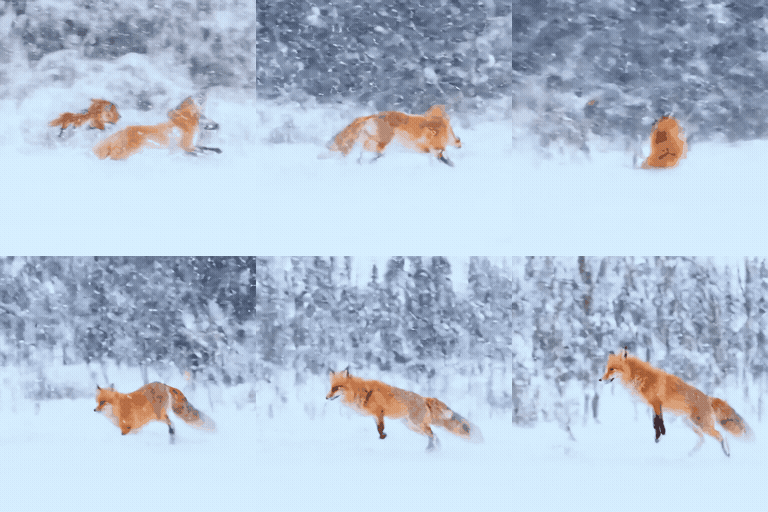
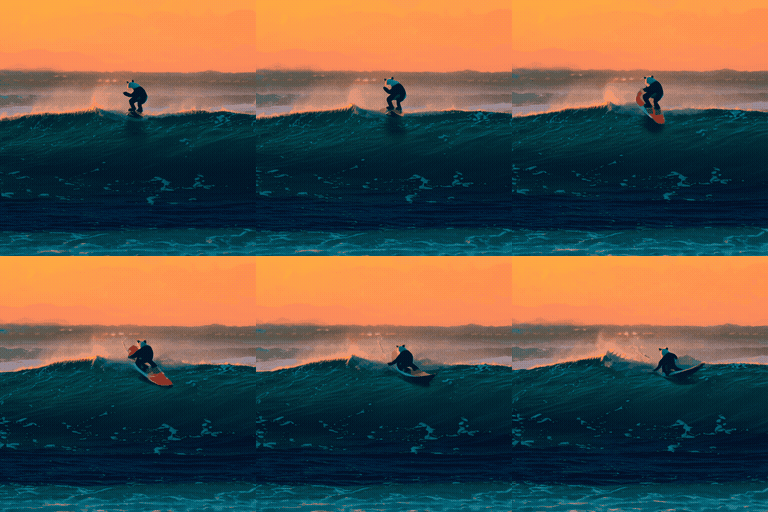
"a red fox trotting through snow" · "a panda surfing a big wave at sunset" — both 256px, generated on a Mac
Components
| Model | Role |
|---|---|
UMT5EncoderModel |
umT5-xxl text encoder (5.6B params; loadable 4-bit ≈ 3 GB) |
WanTransformer3DModel |
the diffusion transformer (DiT) operating on video latents |
AutoencoderKLWan |
causal 3D VAE, ÷8 spatial and ÷4 temporal compression |
Each is a faithful port of the diffusers/transformers reference and is verified
numerically against it (scripts/check_wan_vae.py, scripts/check_wan_transformer.py).
One-line generation
from mlx_diffuser import WanPipeline

pipe = WanPipeline.from_diffusers("checkpoints/wan2.1-t2v-1.3b")  # converts on load
video = pipe(
    "a red fox trotting through snow, cinematic",
    num_frames=17, height=256, width=256, num_inference_steps=30,
)                                              # (1, T, H, W, 3) in [-1, 1]
from_diffusers quantizes the text encoder to 4-bit and keeps the transformer in
bf16 by default; pass quantize_transformer=4 to shrink it further. num_frames
must be 1 + 4k (the VAE's temporal stride) and height/width multiples of 8.
The full runnable script is examples/wan_text_to_video.py,
which also handles the one-time checkpoint download.
The checkpoint converter
Loading official weights is the job of mlx_diffuser.converters. A Converter
maps one diffusers component folder onto the matching MLX model:
from mlx_diffuser.converters import get_converter

vae = get_converter("AutoencoderKLWan").convert("checkpoints/wan2.1-t2v-1.3b/vae")
dit = get_converter("WanTransformer3DModel").convert(
    "…/transformer", dtype=mx.bfloat16
)
It reads safetensors natively (no PyTorch), reorders conv kernels to channels-last,
and uses a build-and-fill check: the target model is instantiated and every one
of its parameters must be covered with a matching shape, so an architecture
mismatch fails loudly instead of silently decoding to noise. convert(...,
quantize=4) weight-quantizes during load, and because safetensors are memory-mapped
lazily, quantizing the multi-GB encoder never holds it all in RAM at once.
Memory notes
- umT5 4-bit ≈ 3 GB, DiT bf16 ≈ 2.8 GB, VAE ≈ 0.25 GB → fits comfortably on a
16 GB Mac. The pipeline can also release the text encoder after encoding
(
release_text_encoder=True, the default) to free memory before denoising. - Smaller
--size/--frames/--stepscut runtime and memory substantially.
Going faster
The denoising loop runs the two classifier-free-guidance passes as a single
batched forward, so there's only one transformer call per step. At 1.3B the model
is compute-bound (attention + matmuls), so mx.compile and batching shave only a
few percent — the real levers are caching and quantization.
First-Block Cache (cache_threshold) exploits the fact that adjacent denoising
steps produce nearly the same transformer output: it computes only the first block,
and when that block's contribution has barely changed it reuses the cached residual
of the other ~29 blocks. Measured on the 1.3B model at 256px / 25 steps:
cache_threshold |
speedup | quality |
|---|---|---|
0.0 (default) |
1.0× | exact |
0.1 |
~1.5× | no visible change |
0.2 |
~2.2× | no visible change (different sample) |
≥ 0.3 |
3×+ | degrades — avoid |
video = pipe(prompt, num_frames=17, height=256, width=256,
             num_inference_steps=30, cache_threshold=0.2)   # ~2.2× faster
It perturbs the trajectory, so the sample differs from the exact run (like changing the sampler) but stays sharp and coherent up to ~0.2; it's off by default.
8-bit transformer halves the DiT's weight memory (2.6 GB → 1.4 GB) at essentially no quality cost (cosine 0.99996 vs bf16):
pipe = WanPipeline.from_diffusers(folder, quantize_transformer=8)
Benchmark the transformer hot path yourself with
scripts/bench_wan.py.