Visual effects
Skywalker has three effect systems that share one workflow: create from a preset with fx_create, tweak a few fields, look, measure. CPU particles are deterministic and countable, so gameplay can depend on them. GPU particles run on compute shaders with millions of particles, collisions against everything on screen, sub-emitters, ribbons, mesh particles and flipbooks, for visuals only. Volumetric fluids simulate fire and smoke as a real gas on a 3D grid and light the scene around them.
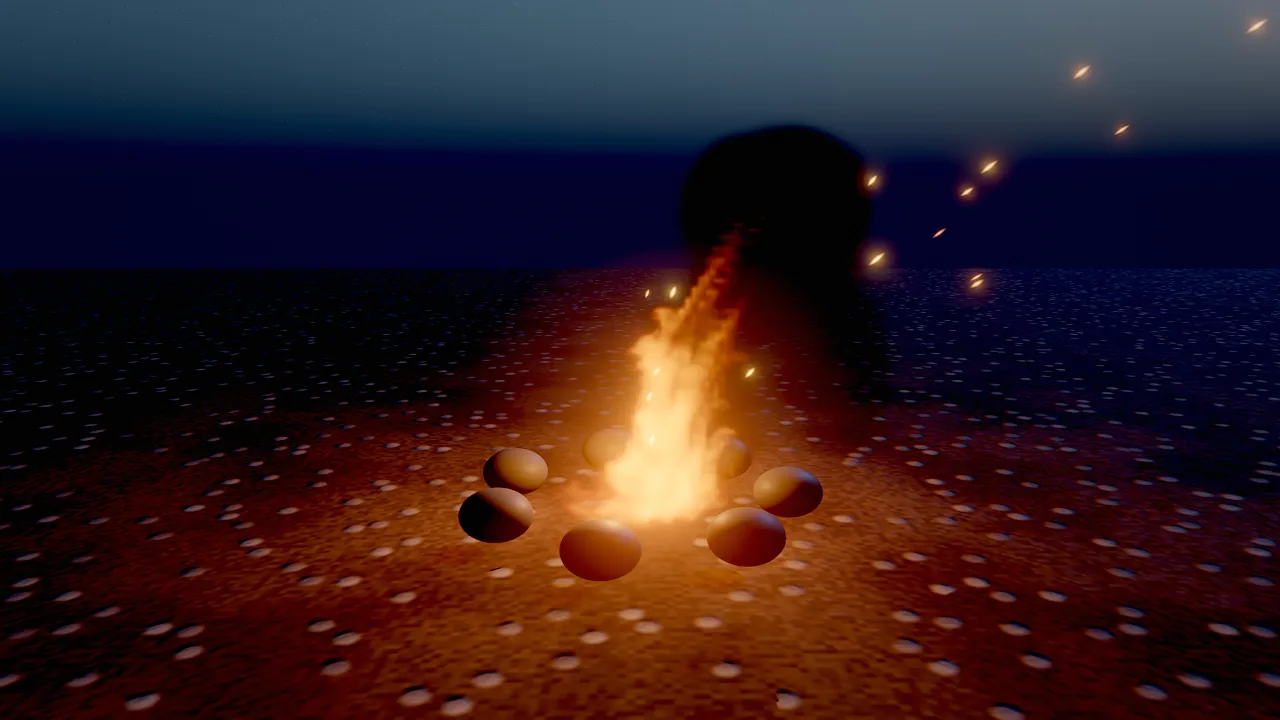
fx_create {"effect": "campfire"} at night: a volumetric fluid fire, particle embers and the flickering light the fire casts on the stones and ground.Concepts
Choosing a system
| Need | Use | Why |
|---|---|---|
| Effects a game rule depends on (hit sparks that count, pickups, weather a script reads) | CPU particles (simulation: "cpu", the default) |
Deterministic, seeded per emitter, replay identically; up to 50,000 per emitter |
| Large visual effects: storms, fireworks, vortices, leaves, grinder sparks | GPU particles (simulation: "gpu") |
Up to 4,000,000 per emitter, collisions with the visible scene; not deterministic and invisible to gameplay |
| Hero fire and smoke, explosions that light a scene | Volumetric fluids (fluid component) |
A real gas simulation, ray-marched; keep to one or two on screen |
| A complete fire with embers and light | Composites: campfire, torch, burning_barrel, explosion |
Fluid plus particles plus light in one call |
| Water surfaces | water component |
See Water |
The particles component
One particles component covers both CPU and GPU emitters. The important fields:
| Group | Fields |
|---|---|
| Emission | emitting, rate (per second), burst (once at start), maxParticles, lifetime (+ lifetimeJitter), shape (point, sphere, box, disc, cone) with shapeSize, direction, speed (+ speedJitter), spread, prewarm (start fully developed), seed |
| Forces | gravity (negative rises like hot gas), drag toward the moving air, wind (environment wind influence), turbulence and turbulenceScale (a divergence-free curl-noise swirl, so smoke curls instead of jittering) |
| Appearance | look, colorStart, colorEnd, sizeStart, sizeEnd (+ sizeJitter), intensity (HDR; glows with bloom above about 1), stretch, spin, softness (fade where particles meet geometry) |
| Space | worldSpace: particles stay behind when the emitter moves (trails) |
| Collision | collide with a floor plane at floorHeight: die, bounce, or splash into droplets |
| Light | light > 0 casts a point light (lightColor, lightRange) whose strength follows the live particles, so it flickers with the simulation |
Looks (look):
| Look | What it draws |
|---|---|
flame |
Procedural fire tongues: tapering, swaying, noise-eroded, with a heat ramp from a yellow core to red tips; partly opaque so overlaps keep their hue |
smoke, mist |
Lit billowing volumes: the sun with shadows and forward scattering, sky light and every point light |
glow |
Soft light points: embers, fireflies, magic |
spark, rain |
Velocity-stretched streaks; rain glints under lamps |
snow |
Soft flakes |
sprite |
A texture or flipbook sheet (GPU only) |
All looks are soft particles that fade where they meet geometry.
CPU particles
The engine simulates CPU particles on the fixed tick, seeded per emitter. In play mode they are deterministic: the same scene replays the same particles, and agents can count and test them. They also preview live while you edit.
Presets: fire, embers, smoke, steam, sparks, rain, snow, mist, spray, dust, fireflies, magic, fireball, debris_smoke, shrapnel, and the cheap composite sprite_campfire.
GPU particles
Set simulation: "gpu" (or start from a GPU preset). Each frame and emitter, the GPU emits from a dead list into an alive list, simulates with an indirect dispatch sized by the live count, writes indirect draw arguments and optionally sorts and reduces lights. Pools, lists and counters live on the GPU; nothing is allocated per frame and nothing is read back for drawing.
| Feature | Fields |
|---|---|
| Emission | rate (up to millions per second), burst, fx_burst and Wander burst(); shapes plus mesh emission from the surface of shapeMesh (or the entity's mesh), leaving along the normal |
| Forces | Gravity, drag, wind, curl noise (two octaves of analytic gradient-noise curl), and a force field: vortex (swirl around fieldAxis with fieldPull and fieldLift), attractor (toward fieldCenter), or texture (a 3D vector field from an .fga file over fieldSize), with fieldStrength and fieldRadius |
| Collisions | The collide floor plane, colliders (entity names: sphere meshes collide as spheres, planes and quads as planes, other meshes as bounding spheres) and depthCollision: everything visible collides through the scene depth and normals. Response: bounce with friction, stick, or die |
| Sub-emitters | subEmitter (another GPU emitter, by name) spawned on subEmitOn death, collision or both, with subEmitCount and subEmitInherit (velocity fraction). Requests pass on the GPU in the same frame: sparks to embers, rockets to bursts, rain to splashes. hueVariation gives each burst its own colour |
| Curves | colorGradient ("#rrggbbaa@t ..."), sizeCurve and opacityCurve ("value@t ..."), baked into 32-entry tables |
| Facing | camera (billboards), velocity (stretched by stretch), horizontal (flat on the ground: ripples, decals), ribbon (trails from a per-particle history: trailLength seconds, trailSegments), mesh (instanced meshes lit by the standard surface shader and casting shadows: mesh is a primitive, an asset or a built-in fx:leaf, fx:shard, fx:pebble; with roughness, metallic) |
| Flipbooks | look: "sprite" with texture, flipbookColumns, flipbookRows, flipbookFps (0 = once over each life); neighbouring frames cross-fade |
| Lighting | Lit looks receive the sun with shadows, the sky and the strongest lights; premultiplied alpha |
| Sorting | Blended looks are sorted back to front on the GPU (bitonic sort); sort: false skips it |
| Light | light > 0: the GPU reduces the live particles to up to 4 clustered point lights, read back asynchronously (a frame or two late, never stalling) |
| Temporal AA | Particles write a reactive mask, so fast sparks and rain do not leave ghost trails |
Presets. Single emitters: ember_storm, magic_vortex, dust_storm, falling_leaves (place about 6 m up), snow_heavy (about 12 m up), smoke_column_gpu, and the building blocks sparks_gpu, embers_gpu, rain_gpu, splashes_gpu, rockets_gpu, firework_burst_gpu, mist_gpu, droplets_gpu. Composites wired with sub-emitters: sparks_shower, fireworks, rain_heavy, waterfall_mist.
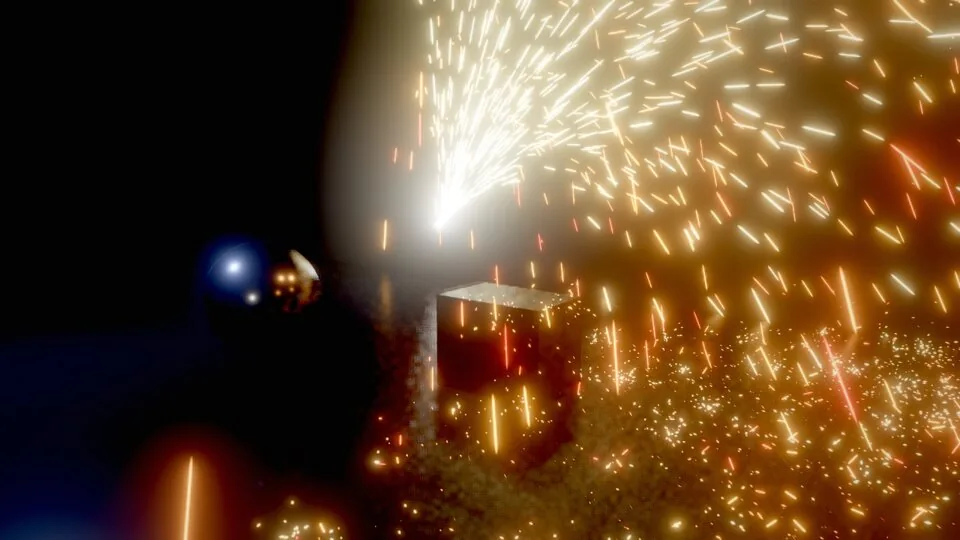
sparks_shower: depth collisions bounce sparks off the props; embers spawn as sub-emitter particles
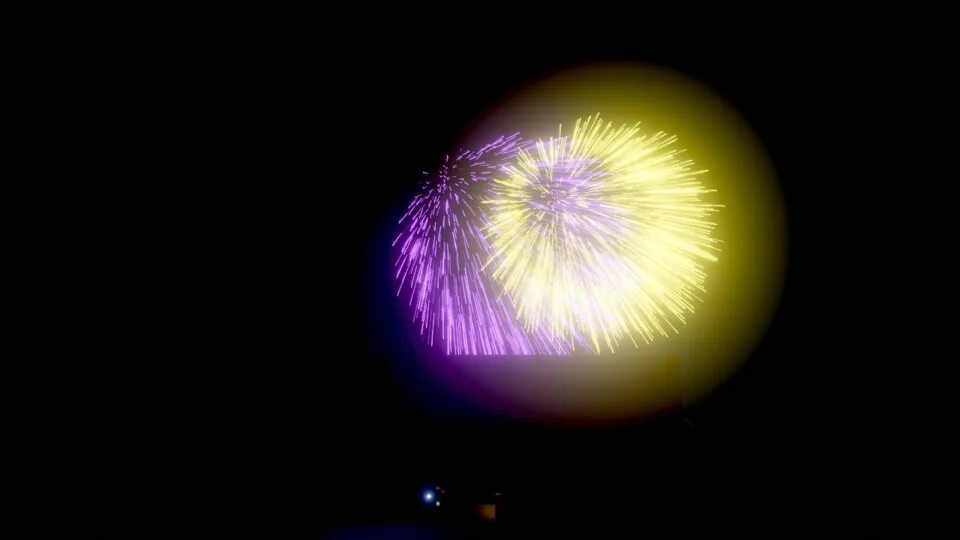
fireworks: rockets whose death spawns bursts, each with its own hue
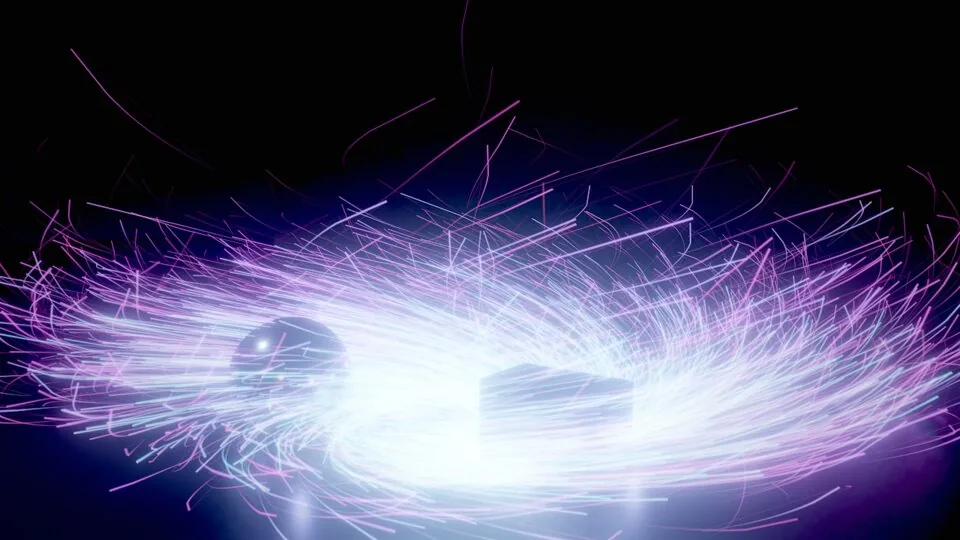
magic_vortex: a vortex force field; each particle draws a ribbon trail
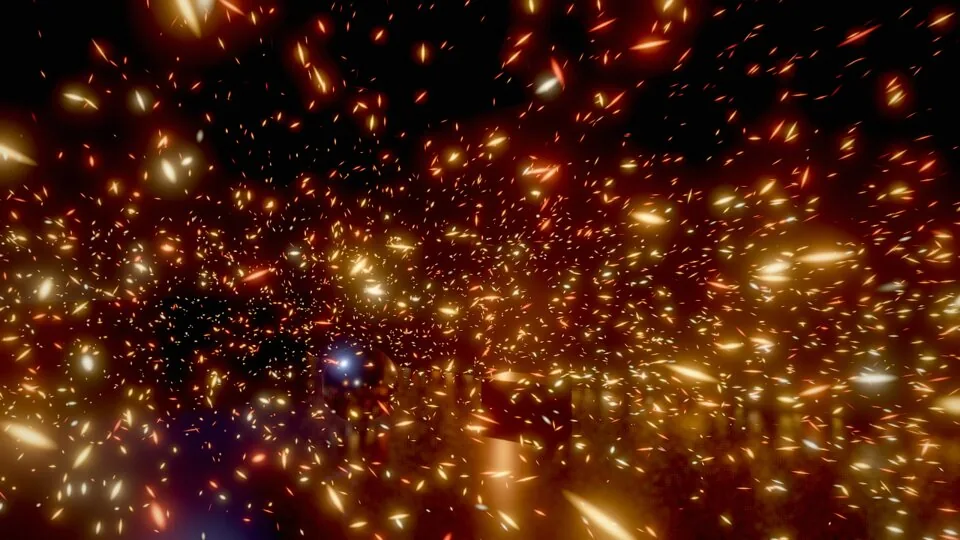
ember_storm
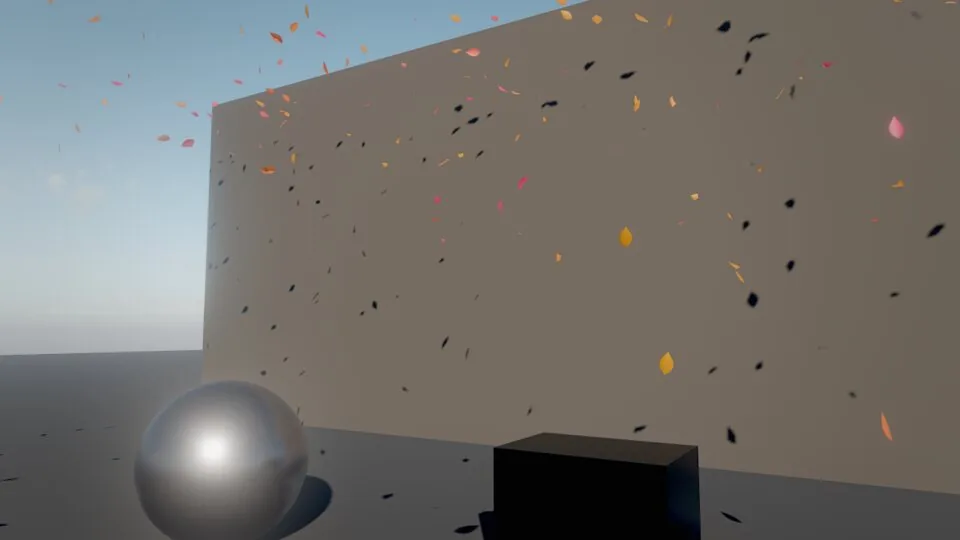
falling_leaves: lit fx:leaf mesh particles
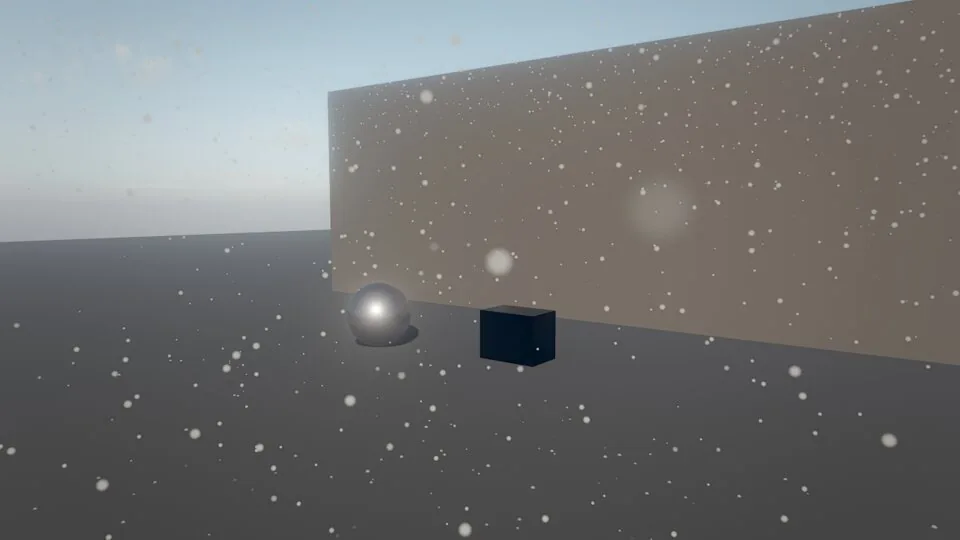
snow_heavy
Volumetric fluids
The fluid component simulates fire, smoke, steam and explosions as an Eulerian gas on a GPU 3D grid inside a box that sits on the entity (bottom centre):
- Solver.
resolutioncells (16–192) along the longest side ofsize. Second-order MacCormack advection with a limiter; combustion (fuelburns atburnRateintoheatandsmoke); buoyancy; vorticity confinement (vorticity: licking flames, curling smoke); sourceturbulence; environmentwind; then a Jacobi pressure solve and projection (incompressible flow, solid floor, open sides and top). Fluids are prewarmed, so a fire starts already burning, andburstgives seconds of heavy fuel for explosions. - Rendering. Ray-marched per pixel with jitter: flame emission from blackbody temperature (
flameTemperature, Kelvin, withflameIntensity), smoke lit by the sun through a shadow march with a forward-scattering phase, sky light, every point light and the fire's own glow (smokeColor,smokeDensity). The march stops at opaque geometry. - Light.
light> 0 casts a flickering point light from the fire onto the scene (lightColor,lightRange).
| Field | Meaning |
|---|---|
size, resolution |
Box in meters; cells along its longest side (detail against cost) |
sourceOffset, sourceRadius, speed |
Where and how fast gas enters |
fuel, heat, smoke, burnRate |
Combustion; lower burnRate gives taller flames; fuel 0 = smoke or steam only |
buoyancy, vorticity, turbulence, wind |
Motion |
cooling, smokeFade |
How fast heat fades and smoke thins |
emitting |
Feed the source; off, the fire dies down |
burst |
Seconds of heavy fuel at start |
seed |
Variation |
Presets: volume_fire, volume_torch, volume_smoke, steam_vent, explosion_volume. The composites campfire, torch, burning_barrel and explosion combine them with particle embers or shrapnel and a light. Fires light their surroundings by themselves; add a separate point light only for a stylized pool of light.
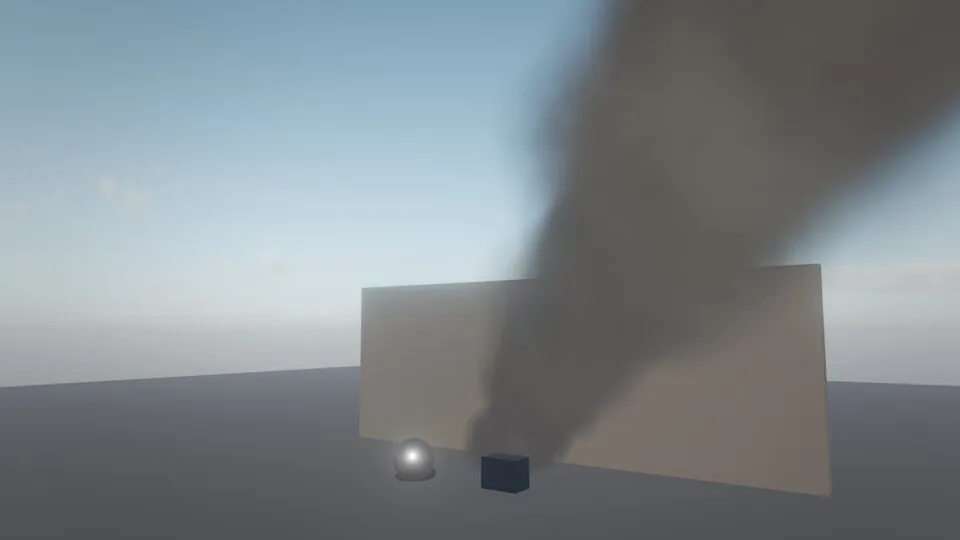
smoke_column_gpu: lit GPU smoke, sorted on the GPU, drifting with the environment wind.How to create an effect
behavior Brazier
  intent "A brazier that flares up with a burst of sparks when the player lights it, then burns."
  var lit = false

  on start
    self.particles.emitting = false
  end

  on trigger_enter "player"
    if not lit then
      lit = true
      self.particles.emitting = true
      burst(60)
      play_sound("audio/whoosh.wav", 0.8)
    end
  end
end
overrides patches the fields of the particles (or water) component; for composites it is applied to every emitter. Place effects at the right scale: a campfire is about 1 m across, a torch small, an explosion 5–15 m.
Bursts
fx_burst {"entity": "Camp Fire", "count": 60}
sim_control {"action": "step", "ticks": 20}
viewport_capture {"eye": [4, 2, 6], "target": [0, 0.8, 0], "samples": 8, "annotate": false, "overlays": false}
fx_burst emits from an emitter (or from every emitter under a composite) right now, while editing or playing; the default count is the emitter's burst field, else 50. A still taken immediately after a burst shows nothing: step a few ticks first. In Wander, burst(n) emits from the behavior's own entity and burst(entity, n) from another emitter.
Build a GPU emitter from scratch
entity_create {"name": "Tornado", "position": [0, 0.3, 0], "components": {"particles": {"simulation": "gpu", "look": "smoke", "facing": "camera", "field": "vortex", "fieldLift": 3, "fieldPull": 2, "rate": 4000, "maxParticles": 200000, "lifetime": 5, "colorStart": "#8a7660"}}}
entity_create {"name": "Ship Trail", "parent": "Ship", "components": {"particles": {"simulation": "gpu", "look": "glow", "facing": "ribbon", "worldSpace": true, "trailLength": 1.2, "trailSegments": 24, "rate": 60, "colorGradient": "#aaddff@0 #3366ff@0.5 #00000000@1"}}}
entity_create {"name": "Explosion Flipbook", "position": [0, 1, 0], "components": {"particles": {"simulation": "gpu", "look": "sprite", "texture": "fx/explosion_sheet.png", "flipbookColumns": 8, "flipbookRows": 8, "flipbookFps": 24, "burst": 1, "rate": 0, "intensity": 2, "lifetime": 1.2, "sizeStart": 3, "sizeEnd": 3}}}
Chain emitters with a sub-emitter
entity_create {"name": "Grinder Embers", "position": [0, 1, 0], "components": {"particles": {"simulation": "gpu", "look": "glow", "rate": 0, "lifetime": 1.5, "sizeStart": 0.03, "gravity": -1, "colorStart": "#ffb050"}}}
entity_create {"name": "Grinder", "position": [0, 1, 0], "components": {"particles": {"simulation": "gpu", "look": "spark", "facing": "velocity", "rate": 3000, "speed": 9, "spread": 25, "direction": [1, 0.3, 0], "depthCollision": true, "bounce": 0.4, "friction": 0.3, "subEmitter": "Grinder Embers", "subEmitOn": "collision", "subEmitCount": 2}}}
Recipes
| Effect | How |
|---|---|
| Grinder sparks bouncing off props | sparks_shower near the props (depth collision is on); aim with the Sparks child's direction |
| Tornado | magic_vortex with look smoke, facing camera, fieldLift 3, a dust-brown colorStart, rate 4000 |
| Paint splatter that sticks | stick: true, depthCollision: true, look glow, small sizeStart |
| Leaves blowing past | falling_leaves 6 m up, environment_update {"windSpeed": 5} |
| Rain with splashes on roofs | rain_heavy (splashes come from depth collisions anywhere) |
| Rainy neon street | rain 12 m up with floorHeight at the street, wet materials (roughness 0.1–0.2), mist at street level |
| Magic trail on a moving object | A child GPU emitter with facing: "ribbon", worldSpace: true |
| Particles shaped like a mesh | shape: "mesh", shapeMesh: "asset:...", low speed |
| Vector field from a DCC app | field: "texture", fieldTexture: "fx/wind.fga", fieldSize = the exported box |
| Flipbook explosion | look: "sprite", texture = the sheet, flipbookColumns and flipbookRows, intensity above 1 for emissive |
| Torch on a wall | torch composite at the bracket; its fluid lights the wall |
| Explosion on demand | An explosion composite saved as a prefab; spawn("prefab:prefabs/explosion.prefab.json", point) from Wander |
Recipe: a mine that explodes
A trigger zone that spawns an explosion prefab, kicks nearby bodies and removes itself. Save an explosion composite as prefabs/explosion.prefab.json first (fx_create then prefab_create).
behavior Mine
  intent "When the player steps on the mine, spawn an explosion, push nearby crates away and disappear."
  param radius = 4 in 1..10 "blast radius (m)"
  param force = 12 in 0..50 "impulse on crates (N s)"

  on trigger_enter "player"
    spawn("prefab:prefabs/explosion.prefab.json", self.position)
    for crate in find_all("crate")
      let d = distance(self, crate)
      if d < radius then
        impulse(crate, direction(self, crate) * force * (1 - d / radius) + (0, force * 0.5, 0))
      end
    end
    destroy self
  end
end
Measuring cost
fx_stats {}
fx_benchmark {"width": 1920, "height": 1080, "frames": 120, "serial": true}
perf_stats {"frames": 30, "passes": true}
fx_stats reports the measured GPU cost of the last rendered frames: the whole frame, the GPU simulation pass (particles and hair), per-emitter live particle counts (read back a few frames late) and per-groom sizes. Render a few frames first. fx_benchmark renders real-time frames back to back with the effects clock advancing 1/60 s per frame and reports GPU time per frame and per effects pass; serial: true waits for each frame so per-pass times do not overlap. Both report 0 on renderers without GPU effects (the CPU fallback renderer).
Measured with fx_benchmark in serial mode on an Apple M1 Pro at 1920×1080; the stage scene alone (floor, props, sky, TAA, GI and reflections, bloom) costs 7.4 ms:
| Workload | Frame (GPU) | Simulation |
|---|---|---|
| 1,000,000 GPU particles, additive glow, curl noise | 16.2 ms (+8.8 ms) | 3.0 ms |
| 1,000,000 GPU particles, lit smoke, GPU bitonic sort | 38.1 ms (+30.7 ms, fill rate) | 8.4 ms including the sort |
To reduce cost: lower maxParticles, prefer additive glow over lit smoke, set sort: false, use smaller particles, lower the fluid resolution, or lower the environment's renderScale.
Pitfalls
- GPU particles are visual only. They are not deterministic and gameplay cannot see them. Anything a game rule depends on must use the CPU path.
- Depth collisions see only the screen. They use the previous frame's depth: particles behind objects or off screen fall through.
- One sub-emitter per emitter. Chains of sub-emitters work up to 4 levels.
- Sorting with glass. Particles and fluid volumes render after transparent meshes, so glass in front of a fire does not sort perfectly.
- Fluid volumes cast no shadows on the scene.
- Rain at ground level. Rain and snow cover a box around the emitter: place it about 12 m above the area and set
floorHeightto the ground. - Washed-out frames. Many overlapping soft particles flood the image; lower
rateorintensity, or raisebloomThreshold. - Pause. Particles of pausable entities stop while the game is paused (see Simulation and time).
For agents
Start from the closest preset, look at it over time, then measure:
fx_create {"effect": "campfire", "name": "Camp Fire", "position": [0, 0, 0]}          # preset at the right scale
sim_control {"action": "step", "ticks": 30}                                           # let it develop
viewport_capture {"eye": [4, 2, 6], "target": [0, 0.8, 0], "samples": 8}             # look close up
viewport_capture {"eye": [4, 2, 6], "target": [0, 0.8, 0], "debug_view": "lighting"}  # is the fire lighting the scene?
fx_stats {}                                                                            # live counts and GPU ms
Capture effects at several moments (start, peak, fade) and from the gameplay camera distance, not only close up. For gameplay effects, confirm the CPU path with sim_trace or particle counts.
Reference
- Tools:
fx_create,fx_burst,fx_stats,fx_benchmark,perf_stats. - Components:
particles,fluid. - Wander:
burst,spawn,impulse. - Related pages: Hair and fur, Water, Performance.
- Design documents: docs/HAIR_AND_VFX.md, docs/RENDERING.md ("Effects").